Ask
“Cumin and cardamom both go in. It smells wonderful while cooking, but by the time we eat it is faint. Should I add more?”
 Join the early-access list
English version in preparation · early access
From one idea
to a dish you never expected.
Recipe drafts from 239 regions of the world, and a Recipe Lab that compares your dish with its neighbours.
A notebook for finding what to cook, trying it, and refining it.
Made in Japan. The Japanese web version works today; the English version is being built with the people on this list.
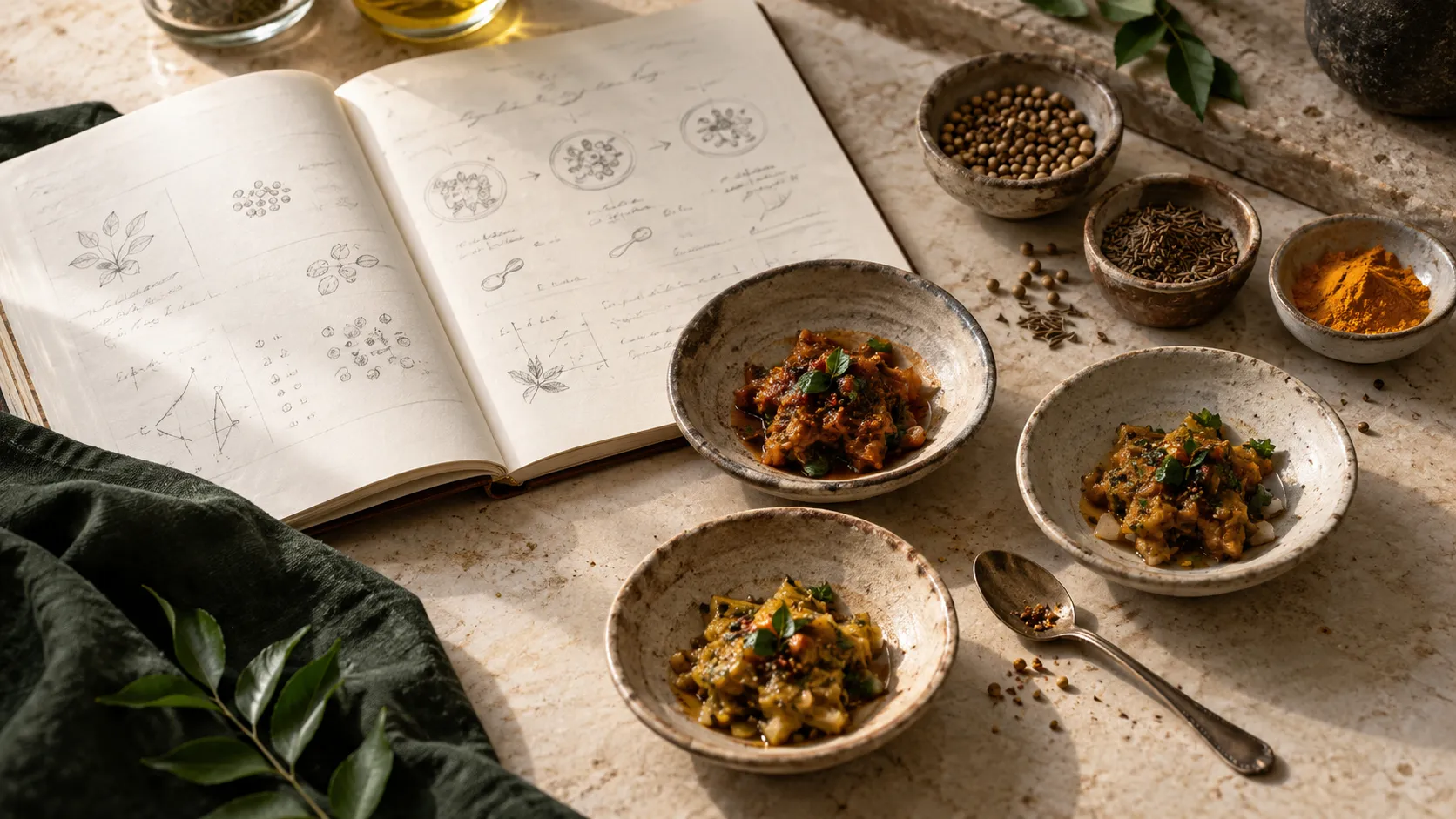
One notebook in your browser: the recipe collection, the Recipe Lab and wine pairing. Move between learning and cooking.
Filter by name, ingredient, cooking time and type, or search by taste, texture and aroma: “very hot, a little sweet”. Anything that catches your eye goes straight into your notebook.
Where it sits among the world's recipes (position). How its ingredients and method differ from its neighbours. What to improve, judged against the typical version and your aim. What happens when you cross it with a dish from another cuisine. Stack the changes you want to try, then save a new version or a new recipe.
Candidates from about 2,000 wines from France, Italy, Japan and the United States, each with its reasoning and caveats. The pairing you choose stays in your notebook with the recipe.
Say it is your usual chicken curry.
“I want more aroma” becomes a way of thinking about how aroma is built.
“Cumin and cardamom both go in. It smells wonderful while cooking, but by the time we eat it is faint. Should I add more?”
Keep the toasted cumin and the depth from the onions. Try one thing: hold back part of the ground cardamom and add it at the end of the simmer, and write down how much.
“Fresh at the first bite. A little powdery.” Next time, the note under that row quotes what you wrote, with its date.
The conversation, suggestions and results are a worked example written to show how the notebook is used, not a real AI answer or a real user's record.
Flavor Assembly is built in Tokyo and runs in Japanese today. The recipe collection is deepest in South Asian, Japanese and Chinese cooking, and we think that depth is most useful to cooks for whom those cuisines are a discovery rather than home ground: in the UK, the United States, Singapore, Australia and Canada first.
Before we translate 11,225 recipes and the sensory vocabulary, we want to talk with about fifteen cooks in those places. Join the list, and if you are willing, tell us you are open to a 45-minute video conversation about how you cook, compare and improve a dish. We will share what we build with the list first.
We read every entry. Interview invitations go out by email from contact@deliberatemachines.ai.
What we store and for how long is in the privacy note below.
Not yet. The web version runs in Japanese, and the recipe texts and the taste vocabulary are in Japanese. Dish names carry English aliases, so you can see what is in the collection, but the English version is what this list is for.
They are drafts Flavor Assembly generated itself, and we have not cooked them. We do not copy recipes or photos from other sites. Each draft passed a format check and an initial AI review, and its page shows that status. Photos are AI-generated images. If you cook one and tell us what happened, that record is what moves a draft forward.
Grams and millilitres first, with cups, ounces and Fahrenheit shown alongside for cooks who use them. Japanese ingredient names will be mapped to what you can buy locally, and we will say when a substitute is a guess. Tell us in the form which units you cook in.
The centre is comparing, not chatting. The Recipe Lab lines up the closest dishes in the collection, you pick one difference, the proposal becomes an untested version, and what you noticed when cooking stays in the notebook for next time.
Pricing for the English version is not set. The Japanese preview has a free plan with a monthly limit on AI answers and paid plans that are not yet on sale. People on this list will hear about pricing before anyone else, and early-access use will be free.
Notebooks in the web version are stored with your account on Cloudflare. When you use an AI feature, your request and the recipe information it needs are sent to our AI provider, currently OpenAI, in the United States. The English version will come with English terms and a privacy policy; this page only covers the waitlist.